The marriage of Prophet Muhammad ﷺ to Aisha bint Abī Bakr رضي الله عنها is often presented as though the entire question begins and ends with her age. Once her age (9 years old) is mentioned, modern categories are immediately applied to it, and the moral judgment is treated as self-evident.
But a number alone tells us remarkably little about a marriage that took place more than fourteen centuries ago. It does not tell us how that society understood childhood and adulthood, when people assumed adult responsibilities, what constituted readiness for marriage, whether the marriage was considered unusual, whether the woman was physically capable of married life, how she experienced the relationship, or what her husband’s broader pattern of behavior tells us about his motives. Those questions require history.
This is where presentism becomes particularly important. Presentism occurs when the assumptions and social categories of the present are projected backward onto people who lived under substantially different conditions. Historians routinely account for this when studying ancient Rome, biblical society, medieval Europe, family structures, warfare, economics, childhood, and political institutions. Ancient societies are first understood within their own historical setting before conclusions are drawn about what particular actions meant.
Yet that method is frequently abandoned in anti-Islamic discussions of Muhammad ﷺ. Seventh-century Arabia is treated as though it operated with twenty-first-century Western concepts of adolescence, compulsory education, economic dependency, statutory adulthood, and marriageability. Eighteen is then treated not as a modern legal threshold, but as though humanity has always recognized it as a universal moral boundary.
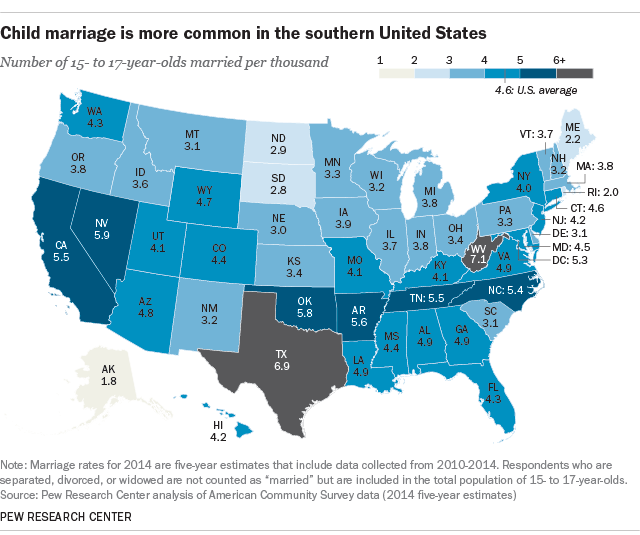
Western legal history alone shows that this is not true. Even the contemporary American category of “child marriage” is far less historically fixed than modern rhetoric often suggests. Pew Research Center found that approximately 57,800 Americans aged fifteen to seventeen were married as recently as 2014. More comprehensive state records indicate that nearly 315,000 minors were legally married in the United States between 2000 and 2021, including, in rare cases, children considerably younger than sixteen. This does not make such marriages appropriate today, nor does it make them equivalent to every marriage in premodern history. It does, however, illustrate how recent the assumption is that eighteen represents a self-evident and timeless boundary separating marriage from “child marriage.” New Hampshire had until recently maintained statutory thresholds of thirteen for girls and fourteen for boys; it raised its minimum to sixteen in 2019 and then to eighteen effective January 1, 2025. Massachusetts did not establish an absolute eighteen-year minimum until 2022. England and Wales allowed marriage at sixteen until legislation enacted in 2022 raised the minimum to eighteen.
None of this means that contemporary societies should reproduce the marriage customs of seventh-century Arabia. Social circumstances have changed, and there are sound reasons for modern governments to adopt higher minimum ages. Islamic law itself is concerned with capacity, welfare, consent, and the prevention of harm. The question is whether a contemporary statutory rule can simply be transported fourteen centuries into the past and used by itself to diagnose the morality and sexual character of a historical person.
This article accepts the traditional Sunni account that Muhammad ﷺ contracted marriage with Aisha when she was six and that married life began when she was nine. Some modern scholars have challenged that chronology, but the defense of the Prophet ﷺ does not require revising the traditional account.
The harder question deserves to be faced directly: even if early marriage was socially accepted, was Aisha رضي الله عنها physically and mentally capable of married life, and is there evidence that Muhammad ﷺ harmed or exploited her? That is the strongest form of the objection, and it is the one the historical evidence must answer.
What the Traditional Account Actually Describes
Ṣaḥīḥ al-Bukhārī records Aisha as reporting that Muhammad ﷺ contracted marriage with her when she was six and that the marriage was consummated when she was nine. Similar reports appear elsewhere in the hadith corpus. The first detail to notice is that the contract and the beginning of married life were not the same event. Approximately three years separated them. This distinction was meaningful. Premodern Islamic law recognized a difference between a valid marriage contract and physical readiness for sexual relations. A marriage could exist legally before the spouses began married life together, and consummation could not simply disregard the bride’s physical condition.
The Hardest Question: What About Physical Harm?
A critic can accept all of this and still ask the central question: even if the marriage was socially normal, could sexual relations at nine have been physically safe?
This question cannot be answered merely by saying that “times were different.” Harm is harm regardless of century, and Islamic jurisprudence itself recognized this principle. Physical capacity mattered independently of the existence of a marriage contract. Classical jurists discussed whether a young bride could safely tolerate sexual relations rather than assuming that a valid contract automatically entitled the husband to immediate consummation. Judith E. Tucker, a historian of Islamic law and gender, describes this distinction in Women, Family, and Gender in Islamic Law. In her treatment of classical marriage law, she explains that a guardian could contract a marriage for a girl before she possessed full legal capacity, while the question of marital relations remained dependent upon her physical readiness. The contract and consummation were therefore not treated as identical legal events: the existence of the former did not, by itself, establish that the latter was appropriate regardless of the girl’s condition.
The ethical principle was therefore not “nine is always safe.” It was that marital relations could not legitimately disregard capacity and harm.
What can we say specifically about Aisha رضي الله عنها? We do not possess seventh-century medical records, nor would we expect to. What the historical sources do preserve is a delayed consummation, family attention to her physical development before she entered Muhammad’s household, and an extensive record of her later life. There is no surviving report from Aisha رضي الله عنها describing physical injury arising from the marriage, and her own extensive testimony about her life with Muhammad ﷺ does not portray the marriage as one in which she was physically harmed.
If Islam Reformed Arabian Marriage, Why Did It Not Prohibit This?
A thoughtful skeptic may press the question further. Islam did not simply preserve every Arabian custom. It reformed many of them. The Qur’an restricted polygyny, prohibited inheriting women against their will, gave women independent property and inheritance rights, regulated divorce, imposed financial obligations upon husbands, and prohibited practices it regarded as unjust.
If marriage at Aisha’s age were inherently harmful, why was this not prohibited as well? This is an important question because Islam clearly was willing to challenge established customs when revelation identified injustice or harm.
Rather than establishing one universal numerical age, Islamic law regulates the conditions and obligations surrounding marriage itself. Among the relevant safeguards are:
- Consent: A woman is not to be married without regard for her wishes. Muhammad ﷺ taught that a women must be consulted and permission must be sought prior to marriage. (Ṣaḥīḥ al-Bukhārī 5136)
- Physical and mental readiness: A valid marriage contract did not automatically mean that marital relations could begin regardless of the wife’s physical condition as seen by the Prophet’s marriage to Aisha.
- Freedom from harm: The Prophetic principle, “There should be neither harming nor reciprocating harm,” became a foundational rule of Islamic jurisprudence. (Sunan Ibn Mājah 2340)
- Proper treatment: The Qur’an commands husbands to live with their wives with kindness, goodness, and fairness. (Qur’an 4:19)
- Financial rights and obligations: Marriage creates enforceable duties rather than merely permitting sexual relations. The Qur’an gives the wife an independent right to her dowry and establishes financial responsibilities within marriage. (Qur’an 4:4)
In addition, Premodern societies, including in America and Europe, also operated under very different demographic conditions. Mortality was far higher and the stages of life were organized differently from those of a modern industrial society. Modern assumptions about a long period of adolescence before assuming adult social and familial roles cannot simply be projected unchanged onto seventh-century society.
The Islamic framework therefore did not treat marriage as permissible merely because a particular age had been reached or because a contract had been signed. It regulated consent, physical and mental readiness, treatment, financial rights, and the avoidance of harm.
This is a coherent moral framework. Revelation targeted practices that produced identifiable injustice or harm. Where the concern was not the number itself but whether the person was capable and protected, the law focused on those underlying conditions rather than freezing one chronological threshold for every society in every era.
That also explains why the same Islamic principles can support a very different legal age today. If contemporary conditions make marriage below eighteen especially vulnerable to coercion, interrupted education, economic dependency, or physical harm, governments can establish a higher minimum to protect those same underlying interests.
What About the Hadith That Aisha Played With Dolls?
One of the most frequently cited counterarguments concerns Aisha playing with dolls.
Ṣaḥīḥ al-Bukhārī records her saying that she used to play with dolls in Muhammad’s presence and that her friends would play with her. When Muhammad ﷺ entered, her friends sometimes withdrew, and he would call them back so they could continue playing together. (Ṣaḥīḥ al-Bukhārī 6130). There is no reason to avoid this narration. Aisha was young, and the report reflects that youthfulness. What it does not establish is that she was physically or mentally incapable of married life according to the standards and circumstances of her society.
Modern readers sometimes encounter an explanatory statement attached to translations of the hadith saying that playing with dolls was permitted because she had not yet reached puberty. That explanation is later commentary, not part of Aisha’s words in the hadith itself. Playing is also a poor universal test of adulthood. Human beings do not suddenly stop enjoying games or youthful recreation at a single biological moment, and cultural expectations surrounding play differ across societies.
In fact, the narration reveals something else about the marriage. Muhammad ﷺ did not insist that marriage erase her interests or force her into an artificial performance of seriousness. When her friends withdrew in his presence, he called them back so they could continue playing with her.
The narration confirms her youth. It does not establish incapacity.
Aisha Had Already Been Considered for Marriage
Early Islamic biographical tradition records that Aisha had previously been promised to Jubayr ibn Muṭʿim. After the death of Khadījah رضي الله عنها, Khawlah bint Ḥakīm approached Muhammad ﷺ and suggested that he marry again, proposing Sawdah bint Zamʿah and Aisha as possible wives.
This establishes an important piece of historical context: Aisha’s eligibility for marriage was not an idea introduced by Muhammad ﷺ. Her family had already considered her for marriage within the ordinary social world in which they lived.
Abū Bakr’s role is also significant. He was not merely Aisha’s father but one of Muhammad’s ﷺ closest companions and most trusted friends, someone who knew his character and private conduct over many years. When Muhammad ﷺ proposed marriage, Abū Bakr did not have any hesitation to have his daughter marry his best friend. Aisha’s own father, who knew him intimately and entrusted him with his daughter did not perceive the marriage as evidence of predatory or morally suspect character.
Muhammad’s Marital History and the “Pedophile” Accusation
The strongest evidence against the modern label “pedophile” is Muhammad’s own adult life. That word does not simply mean “someone who married below today’s legal age.” It makes a claim about sexual disposition: a persistent sexual attraction to children. Muhammad’s marital history does not display that pattern.
He married Khadījah رضي الله عنها as a young man and remained monogamously married to her for approximately twenty-five years. Note, that that it is reported that Khadijah was older than the Prophet. A majority states that she was 40 years old when they married. Their marriage covered the prime of his young and middle adulthood. Only after Khadījah’s death did Muhammad ﷺ enter multiple marriages, largely during the final decade of his life. Most of those women had already been married. They included widows and divorced women. Aisha was notable precisely because she was his only previously unmarried bride. If Muhammad ﷺ had possessed an enduring sexual preference for young girls, this is not the marital history one would expect.
For approximately twenty-five years, he did not pursue that supposed preference at all. When he later possessed the authority to marry multiple women and became a leader in the society, he still did not repeatedly seek girls resembling Aisha. Instead, most of his wives were previously married adult women, devorces and widows. The accusation therefore asks us to infer a persistent sexual pathology from one exceptional marriage while disregarding decades of behavior pointing in another direction.
The Woman Aisha Actually Became
There is another part of the historical record that should not be ignored: Aisha’s own later life. Aisha رضي الله عنها became one of the most important intellectual authorities of the first Muslim generation. She transmitted Prophetic teachings, interpreted the Qur’an, answered legal questions, and openly corrected other Companions when she believed they had misunderstood or inaccurately reported Muhammad ﷺ.
Her corrections were significant enough that the fourteenth-century scholar Badr al-Dīn al-Zarkashī compiled an entire work devoted to them, al-Ijābah li-Īrādi mā Istadrakathu ʿĀʾishah ʿalā al-Ṣaḥābah. Modern scholar Sofia Rehman’s Oxford University Press study of this material examines Aisha’s corrections of prominent figures such as ʿUmar ibn al-Khaṭṭāb, Ibn ʿAbbās, Zayd ibn Thābit, and Abū Hurayrah. Rehman shows that Aisha did not merely preserve reports attributed to Muhammad ﷺ; she evaluated them critically, sometimes challenging other Companions by appealing to the Qur’an, her knowledge of the Prophet’s teachings, and careful reasoning.
This is important because Aisha رضي الله عنها was uniquely positioned to speak about Muhammad’s private life. She lived with him, observed conduct inaccessible to most of his Companions, and then spent decades teaching others what she had witnessed. Yet the tradition does not preserve a passive voice repeating what others told her to say. It preserves a woman willing to disagree with senior male Companions and publicly correct their understanding of the Prophet she knew personally.
Asma Sayeed’s study of women and Islamic religious knowledge places this role within a broader history in which women participated in the transmission of religious learning from Islam’s earliest generations.
None of this makes Aisha’s later accomplishments a substitute for examining the marriage itself. But neither should her actual testimony and life be erased from that examination. The historical Aisha رضي الله عنها was not intellectually silenced by her marriage nor was she a victim. She became known as the “Mother of the Believers” and one of the principal authorities through whom later Muslims came to know Muhammad ﷺ himself.
Aisha also left Muslims an unusually intimate record of married life. She spoke about affection, jealousy, anger, humor, disagreement, worship, household routines, and Muhammad’s behavior toward his wives. Her narrations do not portray someone afraid to acknowledge conflict.
In one well-known report, Muhammad ﷺ told her that he could recognize when she was pleased with him and when she was angry. When pleased, she would swear “by the Lord of Muhammad”; when upset, she would instead say “by the Lord of Abraham.” Aisha readily admitted that he had understood her correctly. (Ṣaḥīḥ al-Bukhārī 5228)
The exchange is valuable because it is ordinary. Aisha could be upset with Muhammad ﷺ. He knew it. She later narrated it publicly. She also gave direct testimony about his treatment of those under his authority, reporting that the Messenger of Allah ﷺ never struck a woman or servant. (Ṣaḥīḥ Muslim 2328a). The woman at the center of the accusation therefore became one of our principal historical witnesses to Muhammad’s private character.
If Aisha’s testimony is relevant when she reports her age, it is also relevant when she tells us how Muhammad treated women and what life with him was actually like.
How Did Muhammad’s ﷺ Society View the Marriage?
Muhammad’s ﷺ contemporaries lived in the same culture as Aisha. They knew its marriage practices from within, knew her family, and knew Muhammad ﷺ personally. The surviving record contains no age-based sexual controversy surrounding the marriage. Much of what we know about early opposition to Muhammad reaches us through Islamic sources, so this point should not stand alone. But the comparison with Muhammad’s ﷺ marriage to Zaynab bint Jaḥsh is useful. Islamic sources did preserve controversy around a marriage when controversy existed. Qur’an 33:37 directly addresses the social difficulty surrounding Muhammad’s marriage to Zaynab after her divorce from Zayd, whom Muhammad had previously treated as an adopted son.
The tradition therefore did not erase every uncomfortable marital controversy. Yet no comparable controversy survives concerning Aisha’s age . Combined with her prior betrothal, family participation, the ordinary proposal process, and the wider marriage customs of the society, the most straightforward conclusion is that her age did not strike the people around them as sexually deviant.
How Recent Is the Eighteen-Year Standard?
Western marriage law provides a useful reminder of just how recently these boundaries changed. In a 1929 debate in the British House of Lords, legislators openly discussed the existing English legal ages of twelve for girls and fourteen for boys. Parliament subsequently raised the minimum to sixteen. Sixteen then remained the minimum in England and Wales for most of the next century, subject to consent requirements. The Marriage and Civil Partnership (Minimum Age) Act 2022 raised the threshold to eighteen.
The American story is even more recent. In 2016, Pew Research Center reported that approximately 57,800 Americans aged fifteen to seventeen were married as of 2014 and that marriage below eighteen remained possible in almost every state through various exceptions. Massachusetts did not establish an absolute minimum of eighteen until 2022. New Hampshire provides an especially striking timeline. Its law historically contained thresholds of thirteen for girls and fourteen for boys. The state moved to sixteen in 2019 and then to eighteen effective January 1, 2025.
Within only a few years, the legal boundary moved from thirteen or fourteen, to sixteen, to eighteen. Human biology did not change during those legislative sessions. What changed was society’s judgment about the best legal rule for protecting young people. That distinction is central to this discussion. Consent, capacity, welfare, education, freedom from coercion, and protection from harm are moral concerns. A statutory age is one tool a society uses to protect those concerns.
Is Muhammad ﷺ Not an Example for All Time?
The Qur’an describes the Messenger of Allah ﷺ as an excellent example for believers. A skeptic may therefore ask why Muslims can defend his marriage while saying that the same age would not be appropriate today.
Part of the answer has already been given. Islam did not teach that nine was the ideal or universal age of marriage. It regulated the underlying moral conditions and outlined the principles such as removing harm, physical and psychological readiness, and consent.
Following Muhammad ﷺ has also never meant mechanically reproducing every incidental feature of seventh-century Arabian life. Muslims do not believe the Sunnah requires abandoning cars for camels, using seventh-century weapons, or reproducing every commercial and social custom of Medina. Some Prophetic actions establish universal obligations. Others demonstrate permissibility or apply general principles within particular circumstances. Islamic jurisprudence has always distinguished among these categories. The enduring lesson from Muhammad’s ﷺ marriage is therefore not “marry at nine.” It is that marriage must operate within legitimacy, capacity, consent, welfare, and freedom from harm.
A Brief Note on Christian Polemics and Selective Historical Judgment
Much of the popular criticism of Muhammad’s ﷺ marriage to Aisha comes from Christian polemics. That makes consistency relevant.
The Bible does not establish any age as a universal divine age of marriage. Biblical society operated with marriage customs substantially different from the modern West, and Christian societies themselves historically recognized marriages at ages that would be unacceptable today. Christian Europe contains numerous well-documented examples of girls entering politically or socially arranged marriages in their early teens, particularly among royal and noble families. Such cases are normally discussed by historians as features of medieval society, not as proof that Christianity itself is sexually predatory.
English law, shaped for centuries by the Christian canon-law tradition, recognized thresholds of twelve for girls and fourteen for boys before Parliament raised them in 1929. Even current Roman Catholic canon law retains a canonical minimum of fourteen for females and sixteen for males, while allowing higher local requirements and separately addressing consent, judgment, and capacity. (Vatican Code of Canon Law, Canon 1083)
When young marriage appears in biblical, medieval Christian, or European history, historical context is ordinarily considered relevant. Yet Muhammad ﷺ is frequently denied that same context. His marriage is removed from its historical environment and treated through modern Western categories as proof of the moral corruption of Islam itself. That selective treatment is where anti-Islamic bias can enter the discussion.
Bias does not make an argument false. But it can influence which historical facts are remembered, which are ignored, and whether the same standards are applied across traditions.
If marriage below today’s age of eighteen automatically demonstrated sexual depravity, that judgment would have to be applied consistently across biblical society, Christian Europe, and relatively recent Western legal history. It rarely is.
Muhammad ﷺ should be judged by the same historical standard granted elsewhere.
Presentism, Anti-Islamic Bias, and the Erasure of Aisha
Not every person troubled by Aisha’s age is motivated by prejudice. Muslims, former Muslims, Christians, atheists, and others can encounter the traditional account and sincerely find it difficult.
Anti-Islamic bias matters at a different level. It can shape which facts are emphasized and which narratives become culturally persuasive.
Western discourse about Muslim societies has frequently portrayed Muslim men as uniquely oppressive and Muslim women primarily as passive victims. Scholars such as Lila Abu-Lughod have examined how the image of the Muslim woman needing rescue became intertwined with broader claims about Muslim societies.
The modern portrayal of Aisha can easily fall into that framework. Muhammad ﷺ becomes the archetypal predatory Muslim male, while Aisha becomes the voiceless Muslim female on whose behalf modern observers must speak. But the historical Aisha keeps intruding upon that picture.
She taught, argued, corrected senior men, participated in public life, preserved intimate details of Muhammad’s household, and became one of Islam’s most important jurists and hadith authorities.
The woman herself is far more complex than the role assigned to her by modern polemics.
Reducing her entire historical identity to the phrase “child bride” creates a powerful emotional but false image. It also obscures most of what the historical sources actually tell us about her.
Selected Sources and Further Reading
- The Qur’an, especially 4:6, 33:21, and 33:37.
- Ṣaḥīḥ al-Bukhārī, especially nos. 5081, 5134, 5136, 5228, and 6130.
- Ṣaḥīḥ Muslim, especially no. 2328a.
- Sunan Ibn Mājah 3324.
- Ibn Saʿd, al-Ṭabaqāt al-Kubrā, biography of Aisha bint Abī Bakr.
- Badr al-Dīn al-Zarkashī, al-Ijābah li-Īrādi mā Istadrakathu ʿĀʾishah ʿalā al-Ṣaḥābah.
- Sofia Rehman, Gendering the Ḥadīth Tradition: Recentring the Authority of Aisha, Mother of the Believers, Oxford University Press, 2024.
- Asma Sayeed, Women and the Transmission of Religious Knowledge in Islam, Cambridge University Press, 2013.
- Judith E. Tucker, Women, Family, and Gender in Islamic Law, Cambridge University Press.
- Kecia Ali, The Lives of Muhammad, Harvard University Press, 2014.
- Lila Abu-Lughod, Do Muslim Women Need Saving?, Harvard University Press, 2013.
- Shadaab Rahemtulla and Sara Ababneh, “Reclaiming Khadija’s and Muhammad’s Marriage as an Islamic Paradigm,” Journal of Feminist Studies in Religion 37, no. 2, 2021.
- Suiqiong Fan and Alissa Koski, “The Health Consequences of Child Marriage: A Systematic Review of the Evidence,” BMC Public Health 22, 309, 2022.
- International Islamic Fiqh Academy, Resolution No. 217 (1/23), 2018.
- Pew Research Center, “Child Marriage Is Rare in the U.S., Though This Varies by State,” 2016.
- Massachusetts Trial Court Law Libraries, materials concerning the 2022 reform establishing eighteen as the minimum marriage age.
- New Hampshire General Court, legislation documenting the progression of the state’s minimum marriage age.
- United Kingdom Parliament, House of Lords debate on the Age of Marriage Bill, February 19, 1929.
- Marriage and Civil Partnership (Minimum Age) Act 2022, England and Wales.
- Code of Canon Law of the Roman Catholic Church, especially Canons 1057, 1083, 1095, and 1103.