An image circulating on social media claims that Islam commands Muslims to terrorize, behead, and kill non-Muslims. But what happens when we compare its twelve quotations with what the Quran actually says?
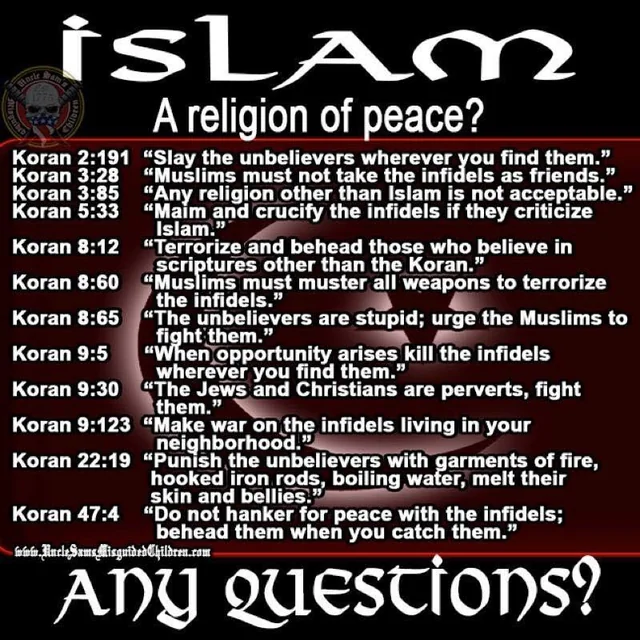
An image circulating on social media asks a provocative question: “Islam: A Religion of Peace?” Beneath that headline are twelve supposed quotations from the Quran, each depicting Islam as a religion that commands its followers to hate, terrorize, or murder people who do not share their faith. The image ends with another challenge: “Any Questions?”
The implication is unmistakable. Muslims may describe their religion as peaceful, but the Quran supposedly tells a different story. The image presents itself as evidence, complete with chapter and verse numbers, giving readers the impression that these are direct quotations from Islam’s most sacred text.
There is just one problem. Several of these statements are not what the Quran says. Others are misleading paraphrases that remove essential context. And some take genuine passages about warfare and transform them into commands for indiscriminate violence against non-Muslims.
This is not a minor disagreement about translation. Consider the difference between a passage addressing an armed conflict and a supposed instruction to murder anyone who believes differently. Or the difference between a verse discussing criminal punishment for violent wrongdoing and an invented command to crucify people for criticizing Islam. These changes fundamentally alter the meaning of the text.
It is entirely legitimate to question the Quran’s teachings about warfare, religious differences, punishment, and political authority. Muslims themselves have debated the interpretation and application of these passages for centuries. Some of the verses discussed below contain language that modern readers will find severe, and an intellectually honest examination should acknowledge that.
But criticism requires accuracy. If someone claims that a religious text commands murder, the least we should expect is that the text actually says what they claim it says.
So rather than accept the image’s invitation to draw conclusions from twelve isolated statements, let’s examine all twelve against the Quran itself.
Before Examining the Verses: How the Quran Discusses Warfare
The Quran was revealed over approximately twenty-three years during the life of Prophet Muhammad ﷺ. Its earliest revelations came in Mecca, where Muhammad and his followers faced opposition and persecution. Later revelations came in Medina, where the Muslim community developed political institutions, entered alliances, negotiated treaties, and fought wars against opposing forces.
This historical development matters because the Quran is not organized chronologically. A verse revealed during a military confrontation may appear alongside passages addressing worship, morality, family relationships, or theological questions. Reading a single sentence without considering its surrounding passage, historical circumstances, or intended audience can create a seriously distorted impression.
The Quran also distinguishes between different categories of people and different circumstances. It discusses those who fight Muslims, those who enter treaties with them, those who remain neutral, and those who seek protection. These distinctions are not incidental. They are central to understanding the rules governing conflict.
For example, Quran 60:8 explicitly permits kindness and justice toward people who have neither fought Muslims because of their religion nor expelled them from their homes. Quran 8:61 instructs Muslims to incline toward peace when an opposing party does so. Quran 2:190 commands fighting against those engaged in hostilities while prohibiting transgression.
None of this means that every Quranic passage concerning warfare can be reduced to immediate self-defense. Classical Islamic jurisprudence developed broader doctrines concerning warfare, treaties, political authority, and relations between states. Muslim scholars have disagreed over how particular verses should be understood and applied.
But these disagreements must begin with the actual text, not invented quotations.
Claim 1: Quran 2:191 — “Slay the unbelievers wherever you find them.”
This is one of the most frequently circulated Quranic quotations in anti-Islamic material. The image presents it as a general command to kill unbelievers simply because they do not believe in Islam.
The actual verse contains language about killing opponents wherever they are encountered, but the passage begins one verse earlier:
“Fight in the cause of Allah only against those who wage war against you, but do not exceed the limits.”
Quran 2:190, The Clear Quran
The following verses discuss fighting, expulsion, persecution, and the cessation of hostilities. Verse 2:192 specifically states that if the opponents cease, Allah is forgiving and merciful. Verse 2:193 continues the discussion of ending persecution and hostilities.
This is not an abstract instruction about how Muslims should treat their Christian neighbor, Jewish coworker, or atheist classmate. It is a passage addressing armed conflict.
Classical commentators discussed the precise scope of these commands, including whether later revelations expanded the circumstances in which Muslims could fight. That interpretive history deserves consideration. Nevertheless, the image omits the immediately preceding restriction against transgression and presents the command as though religious disbelief alone were sufficient grounds for killing.
That is not a faithful representation of the passage.
Read: Quran 2:190–193
Claim 2: Quran 3:28 — “Muslims must not take the infidels as friends.”
The image claims that Quran 3:28 prohibits Muslims from having non-Muslim friends. This interpretation is frequently used to suggest that Muslims are religiously obligated to distrust everyone outside their community.
The verse addresses believers taking disbelievers as awliya instead of believers. The Arabic word awliya has a range of meanings, including allies, protectors, patrons, and close associates. Translating it simply as “friends” can obscure the political and communal dimensions of the passage.
The broader Quranic teaching makes clear that Muslims are not prohibited from maintaining ordinary friendships or peaceful relationships with non-Muslims. Quran 60:8 permits kindness and justice toward non-hostile non-Muslims. Quran 5:5 permits Muslim men to marry chaste women from among the People of the Book, a relationship involving family ties and intimate companionship.
Quran 31:15 goes further by instructing believers to maintain good worldly companionship with parents even when those parents pressure them toward religious beliefs Islam rejects.
There are genuine scholarly discussions about the limits of political allegiance, religious loyalty, and intimate association. But reducing those discussions to “Muslims cannot have non-Muslim friends” is misleading.
If Islam categorically prohibited friendly relationships with non-Muslims, these other Quranic teachings would be difficult to explain.
Read: Quran 3:28, Quran 60:8–9
Claim 3: Quran 3:85 — “Any religion other than Islam is not acceptable.”
Unlike several other statements in the image, this claim substantially reflects the meaning of the verse.
Quran 3:85 teaches that whoever seeks a religion other than Islam will not have it accepted and will be among the losers in the Hereafter. Islam makes an exclusive theological claim about the truth of its revelation and the religious path accepted by God.
That should not be surprising. Many religious traditions make exclusive claims about salvation, revelation, or the nature of God. Christianity, for example, contains passages identifying Jesus as the way to the Father, while Judaism maintains distinctive covenantal claims.
The important distinction is between theological exclusivity and a command to commit violence.
A religion can maintain that its teachings are true without requiring its followers to murder everyone who disagrees. The verse does not instruct Muslims to attack, imprison, or punish adherents of other religions. It concerns religious truth and ultimate accountability before God.
There are substantial debates within Islamic theology about the salvation of people who never received an accurate presentation of Islam, the status of earlier religious communities, and the relationship between faith and divine mercy. Those questions cannot be resolved by pretending that Quran 3:85 does not exist.
But neither can the verse reasonably be transformed into an instruction to kill non-Muslims.
Read: Quran 3:85
Claim 4: Quran 5:33 — “Maim and crucify the infidels if they criticize Islam.”
This is one of the clearest examples of fabricated meaning in the image.
Quran 5:33 does prescribe severe punishments, including execution, crucifixion, amputation, and exile. Those punishments are real, and there is no reason to conceal them. However, the verse addresses those who wage war against Allah and His Messenger and spread corruption in the land.
It does not say that people should be mutilated or crucified for criticizing Islam.
Classical Islamic jurisprudence commonly discussed this verse in connection with hirabah, a category involving violent banditry, armed robbery, attacks on public security, and related serious offenses. Jurists debated which punishments applied to particular acts, including distinctions between robbery, killing, and other forms of violent wrongdoing.
These punishments may still raise serious ethical questions for modern readers. One can question whether they are proportionate or appropriate without misrepresenting the offenses to which the verse refers.
The image does something different. It replaces the verse’s description of violent wrongdoing with the phrase “if they criticize Islam.” That change turns a criminal-law passage into an apparent command to torture people for expressing religious disagreement.
The distinction is enormous. Whatever one’s views about classical Islamic criminal law, criticism of Islam is not the offense identified in Quran 5:33.
Read: Quran 5:33–34
Claim 5: Quran 8:12 — “Terrorize and behead those who believe in scriptures other than the Koran.”
Quran 8:12 contains unmistakably violent language. It refers to striking enemies above their necks and striking their fingertips. The passage is traditionally associated with the Battle of Badr, one of the earliest major military confrontations between the Muslims of Medina and the Meccan forces.
The image, however, adds a qualification that does not appear in the verse: that the targets are people who believe in scriptures other than the Quran.
This changes the nature of the command. The actual passage concerns a military confrontation, not a general instruction to attack Jews, Christians, or anyone who follows another scripture.
The verse also describes Allah addressing the angels and strengthening the believers during battle. That setting is important to understanding its language and purpose.
The word “terror” deserves careful attention. The Quran does speak about fear being cast into the hearts of enemies, and Islamic military thought historically recognized intimidation and deterrence as features of warfare. It would therefore be inaccurate to suggest that the Quran never discusses frightening an opposing force.
But frightening an enemy army during battle is not equivalent to commanding terrorism against civilians because they follow another religion.
The image erases that distinction and inserts an entirely different religious category into the verse.
Read: Quran 8:12
Claim 6: Quran 8:60 — “Muslims must muster all weapons to terrorize the infidels.”
Quran 8:60 commands Muslims to prepare whatever military strength they can, including warhorses, to deter or frighten enemies of Allah and the Muslim community.
The verse clearly concerns military preparedness. It does not instruct Muslims to use every available weapon against every non-Muslim.
There is a fundamental difference between military deterrence and indiscriminate terrorism. Governments throughout the world maintain armed forces partly to discourage potential adversaries from attacking. The ability to deter an enemy through military preparedness is not unique to Islam, nor does it necessarily imply an intention to attack civilians.
The surrounding passage reinforces the distinction. Quran 8:61 immediately states that if the